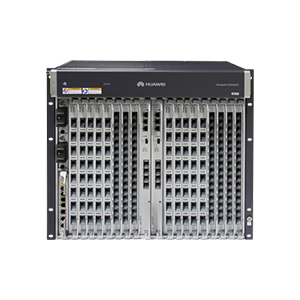
More about the product
- Gigabit aggregation of services transmitted over different media: The MA5800 leverages the PON/P2P infrastructure to integrate fiber, copper networks into one access network with unified architecture. On a unified access network, the MA5800 carries out unified access, aggregation, and management, simplifying the network architecture and O&M.
- Superior 4K/8K/VR video experience: A single MA5800 supports 4K/8K/VR video services for 16,000 homes. It uses distributed caches that provide greater space and smoother video traffic, allowing users to start a 4K/8K/VR on demand video or zap between video channels more quickly. The video mean opinion score (VMOS)/enhanced media delivery index (eMDI) is used to monitor the 4K/8K/VR video quality and ensure excellent network O&M and user service experience.
- Slicing Technology: The MA5800 is an intelligent device that supports slice. The E2E slicing technology provides differentiated bearing for services with different SLA requirements, achieving application-level bandwidth and latency commitment.
- Distributed architecture: The MA5800 is the first OLT with distributed architecture in the industry. Each MA5800 slot offers non-blocking access to sixteen 10G PON ports and can be upgraded to support 50G PON ports. The MAC address and IP address forwarding capacities can be smoothly expanded without replacing the control board, which protects operator investment and allows step-by-step investment.
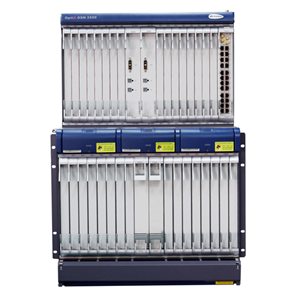
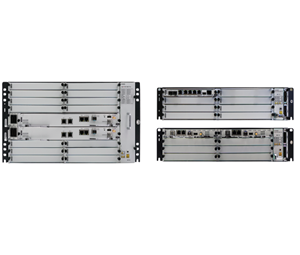
| Parameters | MA5800-X17 | MA5800-X15 | MA5800-X7 | MA5800-X2 |
| Supported cabinet | N63E-22, N66E-18 | N66E-22 | N63E-22, N66E-22 | N63E-22 |
| Board configuration | Control board slots: 9, 10 Service board or upstream interface board slots: 1–8, 11–19 Universal interface board slot: 0 Power board slots: 20, 21 | Control board slots: 8, 9 Service board or upstream interface board slots: 1–7, 10–17 Universal interface board slot: 0 Power board slots: 18,19 | Control board slots: 8,9 Service board or upstream interface board slots: 1–7 Universal interface board slot: 0 Power board slots: 10, 11 | Control board slots: 3,4 Service board or upstream interface board slots: 1–2 Does not support the universal interface board. Power board slot: 0 |
| Dimensions (W x D x H) (mm) | Excluding mounting ears: 493 x 287 x 486 Including mounting ears: 535 x 287 x 486 | Excluding mounting ears: 442 x 287 x 486 Including mounting ears: 482.6 x 287 x 486 | Excluding mounting ears: 442 x 268.7 x 263.9 Including IEC mounting ears: 482.6 x 268.7 x 263.9 Including ETSI mounting ears: 535 x 268.7 x 263.9 | Excluding mounting ears: 442 x 268.7 x 88.1 Including IEC mounting ears: 482.6 x 268.7 x 88.1 Including ETSI mounting ears: 535 x 268.7 x 88.1 |
| Maximum weight (including mounting brackets) | 45 kg | 35 kg | 26 kg | 9.4 kg |
| Maximum input current | 60 A | 60 A | 40 A | DC power supply: 20 A AC power supply: 8 A |
| Power supply mode | DC power support (dual backup) | DC power support (dual backup) AC power supply + battery for backup | ||
| Working voltage range | –38.4 V DC to –72 V DC | DC power supply: –38.4 V to –72 V AC power supply: 100–240 V | ||
| Rated voltage | –48 V/–60 V | DC power supply: –48 V/–60 V AC power supply: 110 V/220 V | ||
| Ambient temperature | –40°C to +65°C The MA5800 can start up at a lowest temperature of –25°C. NOTE: The +65°C temperature refers to the highest temperature measured at the air intake vent of a service subrack. | |||
| Ambient humidity | 5%–95% RH | |||
| Atmospheric pressure | 70–106 kPa | |||
| Altitude | < 4000 m. The air density varies with the altitude and will affect the heat dissipation of a device. Therefore, the working environment temperature of the MA5800 varies with the altitude. | |||
| Payload switching capacity of the control board (load sharing mode) | MPLA: 3.6 Tbit/s MPLB: 7.0 Tbit/s MPLG: 7.3 Tbit/s MPLH: 8.0 Tbit/s | MPSA/MPSG: 248 Gbit/s MPSD: 560 Gbit/s | ||
| Maximum payload bandwidth per service slot (load sharing mode) | MPLA: 100 Gbit/s MPLB/MPLG/MPLH: 200 Gbit/s | MPSA/MPSG: 248 Gbit/s MPSD: 560 Gbit/s | ||
| Maximum payload bandwidth per service slot (load sharing mode) | MPLA: 100 Gbit/s MPLB/MPLG/MPLH: 200 Gbit/s | MPSA/MPSG: 40 Gbit/s MPSD: 100 Gbit/s | ||
| Access ONTs | 34816 | 4096 | ||
| Multicast users | MPLA/MPLB/MPLG: 17408 MPLH: 34816 | 4096 | ||
| Maximum number of MAC addresses | 262143 | |||
| Maximum number of IPv4 routing tables | 65536 | |||
| Maximum number of IPv6 routing tables | 16384 | |||
| Maximum number of ARP tables | 131072 | 32768 | ||
| Bit error rate (BER) in full load | A BER smaller than 10 e-10 for a port that transmits data in full load | |||
| System reliability specifications | System availability for the typical configuration: > 99.999% Mean time between failures (MTBF): about 45 years NOTE: Due to different network environments and different boards used by devices, the preceding MTBF (45 years) of the MA5800 is only for reference. The average repair time for field replaceable units (FRUs) is about 2 hours. The preceding values are only for reference. For details, contact the related Huawei engineers. | |||
| Upstream ports (dual control boards for upstream transmission) | MPLA/MPLB: 8 x 10GE/GE MPLG: 2 x 100GE + 4 x 10GE/GE MPLH: 4 x 100GE + 8 x 25GE/10GE/GE | MPSA/MPSG: 4 x 10GE/GE + 4 x GE MPSD-G: 8×10GE/GE | ||
| GPON ports | 272 | 240 | 112 | 32 |
| XG-PON ports | 272 | 240 | 112 | 32 |
| XGS-PON ports | 272 | 240 | 112 | 32 |
| XG-PON & GPON Comboports | 272 | 240 | 112 | 32 |
| XGS-PON & GPON Combo ports | 272 | 240 | 112 | 32 |
| Symmetric 50G-PON & XGS-PON Combo ports | 16 | 16 | 16 | N/A |
| Symmetric 50G-PON & XGS-PON & GPON Combo ports | 16 | 16 | 16 | N/A |
| GE/FE ports | 816 | 720 | 336 | 96 |
| 10GE/2.5GE/GE ports | 408 | 360 | 168 | N/A |
| 10GE/GE ports | 408 | 360 | 168 | 16 |